"No One Can Do It Like Me" Is a Lie (And It's Costing You)
For most of my life, I believed that if I wanted something done right, I had to do it myself. I held it all the way until I had a panic attack and had to stop doing everything myself. I made changes, and you know what?
I learned that being a solopreneur doesn’t mean doing everything yourself. It means you own the business and work on your own terms — not that you personally execute every task.
In this episode, I break down how to tell the difference, why “no one can do it like me” is a story we tell to protect our feelings, and how one client almost stopped doing her show because she wouldn’t let go of a single task. Then I give you the one small thing to try this week.
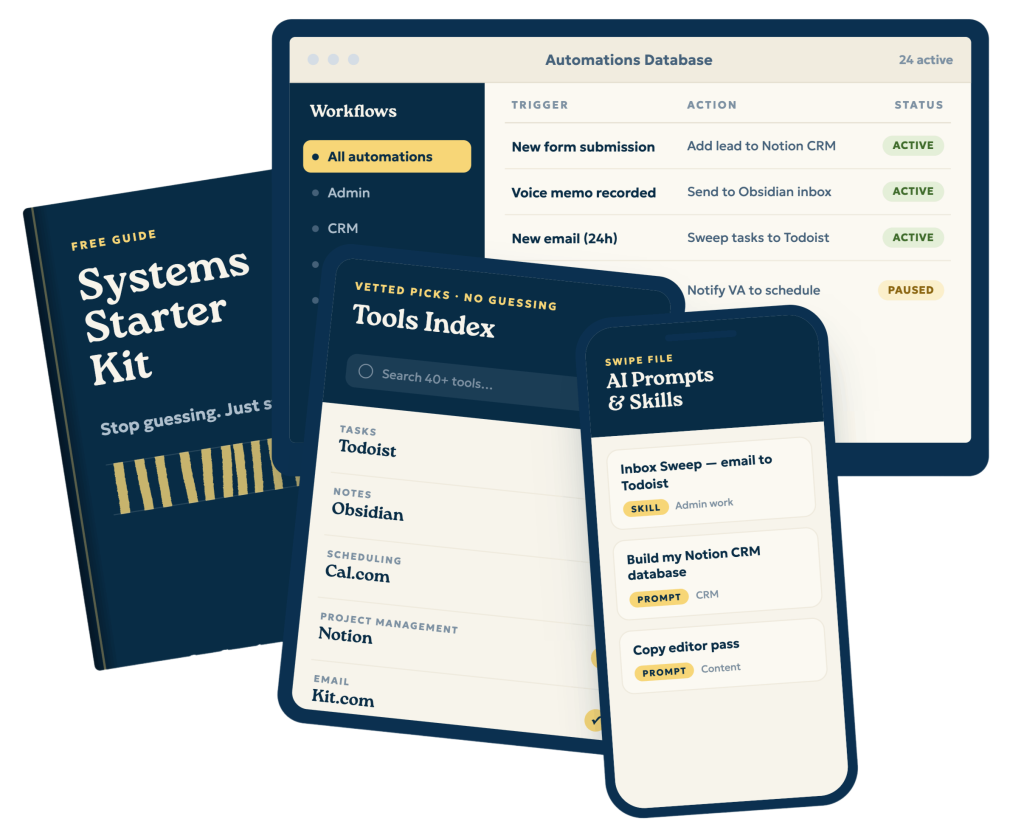
Looking for a place to start? Grab the free Solopreneur Systems Starter Kit — the 4 systems every solopreneur needs, plus the exact tools, automations, and AI prompts to set them up: https://streamlined.fm/kit
Linked
- (00:00) – The Myth of Doing It All Yourself
- (03:44) – What Being a Solopreneur Actually Means
- (05:13) – Auditing Your Tasks
- (08:46) – Solopreneur System Starter Kit & Wrap-up
————
Streamlined Solopreneur helps overwhelmed coaches, consultants, and service providers build systems so their business doesn’t depend on them.
Each week, Joe Casabona shares one practical idea — a system, tool, or strategy, with AI doing the tasks, not the thinking — to help you beat overwhelm, get your time back, and run your business without sacrificing the rest of your life, or your health.
Looking for a place to start? Download the Solopreneur Systems Starter Kit: the 4 systems every solopreneur should have, the simplest way to set them up, plus the exact tools, automations, and AI prompts you need. No guessing. Get it free at https://streamlined.fm/kit.
Connect with Joe on LinkedIn: https://www.linkedin.com/in/jcasabona/
Transcript
This idea had such a stranglehold on me that I did everything myself until I couldn't back in 2020, when I had a panic attack and then things had to change. And you know what? I learned that I don't have to do everything myself. And that's what I want to talk about today.
Hey everybody, and welcome to another episode of The Streamlined Solopreneur, the show that helps overwhelmed coaches, consultants, and service providers build systems so their business doesn't depend on them. Each week I share one practical idea, system, tool, strategy, way to use AI for tasks and not thinking to help you beat overwhelm, get your time back, and run your business without sacrificing the rest of your life or your health.
And today I want to cover a big one. And that is the idea that being solo, being a solopreneur, means that you have to do everything. No one can do it like you, and you can't trust anybody else. This is something that people have said to me on calls. I don't trust anybody else to do it the way that I do it.
And the truth is I believed that for a very long time. A lot of us believe that. I think we all like to believe that we are special and unique, and the way that we do things is so different. But here's the hard truth. Yes, there are a few things that you do that are really uniquely you. I know that I think a certain way that most business owners don't think. I know that my skill and relationship with technology is different from most people, something that my wife simultaneously reminds me of and thanks me for regularly.
But there are a lot of things that I held onto that anybody else could do. In fact, some people do it better. My VA does a lot of things better than I would do them, because when you are trying to do everything yourself, you do a lot of things poorly, right? There's the idea, to quote Ron Swanson, don't half-ass 2 things, whole-ass one thing, right? And this is the idea that I try to communicate to solopreneurs all the time. Because I mean, to draw on another personal story, right? When I had that panic attack, and I made a bunch of changes, less than a year later, I took 6 weeks off for Christmas vacation and then a month of paternity because our youngest daughter was born. So you don't have to do everything yourself. And the sooner you learn that, the better off your business will be.
Being a solopreneur doesn't— like nobody's an island, right? We all need help from somebody. And that might not mean delegating. In a lot of ways, and a lot of times, that means automating, using technology to your advantage to do those repeatable, planned processing tasks that you don't have to do.
So what does being a solopreneur actually mean? It means that you own the business, that you do things on your time, not that you need to personally execute every task. And here's, here's a really good example of that, right? Someone a few years ago asked me like what my exit strategy for my business was. I hate this question because I didn't start a business to exit it. Right. I don't like the term serial entrepreneur. To me, that just sounds like somebody who can't focus long enough to build an actual business. But for me, I want to be my business, and I want to be able to step away from my business when I want to. So I don't want to have to worry about a bunch of employees and what happens when things go wrong. I want to have the relationship between me and my clients. And a couple of contractors who work independently and do not rely on me as their sole source of income. That's the kind of business I want.
Does that mean that I'm going to be a millionaire or a billionaire or a bajillionaire? No, but it means that if I want to go see a movie on a Wednesday morning or take the day off to spend time at my kid's field day, that I can, and I can leave my phone in the car and not have to worry that things are going to crumble or an employee needs me. Or payroll didn't run or something weird like that. So, you own the business. You don't have to personally execute every task.
What can you do to figure out what you should be doing? Well, the way to figure out the things that you should do is make a list of all the tasks you do and put a checkmark next to the things that only you can do and an X next to the things that somebody else can do. And I want you to be really honest with yourself here.
The thing that I usually say to people is it requires you if it needs your brain or your voice. So like, I can't have somebody else record this podcast for me. I don't have somebody else or something else write this podcast for me either. This podcast is my brain and my voice. When I'm doing client work, right? When I'm building a system for somebody or running a group program or doing a roadmap call, that requires my brain. I don't delegate that out. Some people who build a team of coaches and have a methodology, right? That is something that they can delegate out. That's not something that I can delegate out.
But posting to LinkedIn, publishing these podcast episodes, gathering the show notes to an extent, right? AI has gotten good enough that it can reliably gather show notes, and with Claude, it knows my affiliate links, and I don't really have to worry about that part anymore.
So there, all in one example, right? With my podcast, it requires my brain and my voice, nothing else, right? I can have somebody edit my episodes if I want. My VA publishes the episodes. Automation will move files into folders and send emails. Automation will gather the show notes and even take a first crack at the description because it, I basically say, use my opening story and then summarize the episode. That is how I write the show notes or the description for each episode. Heck, now it can even create the custom artwork for me because I use a template and it's very clear what I want. My VA also does that, though. So there's an example. There's what you should do.
And here's some proof, right? A client of mine, Laura Brazan, she was on back in December, right? There's a case study episode. I'll link that in the show notes. Went like kicking and screaming, resisting giving up the guest approval, right? She didn't want to let this part go. I'm using kicking and screaming because I'm pretty sure that's the language that she used. I should maybe double-check that, but I think that's the language that she used. But then she said, and this I actually do have the quote for, “If I had done it the way I wanted to, the show would not be on now.”
I was able to help her see that she was doing something that she did not need to do. And that's the other side of it, right? When I say remove, I said, I have said automate or delegate. The other one is just remove it, right? Maybe you're gonna go through your list and be like, why do, why do I do this now? I simplified my publishing process a few years ago and I realized like, why am I publishing transcripts this way when I can do it this other better way? So here's the lie, right? Being a solopreneur means doing everything myself. Nobody else can do it as well as me. That's a very nice thing to tell yourself to protect your feelings, but it's demonstrably not true.
So here's the one small thing that you can do this week. List this week's tasks. Mark 3 of them that only you can do. Everything else is a candidate to automate, delegate, or eliminate. That's it. The 3 tasks you can do; everything else is a candidate. If you take that one step today, you will start realizing, hey, I don't have to do everything myself.
And hey, if you're wondering like how you can build better systems around this and how to understand how you work better, check out my Solopreneur System Starter Kit. It's the 4 systems that every solopreneur needs to start removing you from the loop a little bit more, to automate more, to track things better. And specifically in the admin system, the very first system in the kit, I talk about how you can better guard your time. That's going to be over at streamlined.fm/kit. I will put that as a link in the show notes as well.
But that's it for this episode of The Streamlined Solopreneur. I hope you enjoyed it. Go check out the Solopreneur System Starter Kit. That's a mouthful. And remember, being a solopreneur does not mean doing everything yourself.
Thanks so much for listening. And until next time, I hope you find some space in your week.