

How Solopreneurs Can Take More Time Off
Earlier this year, I went to Podfest and it was a blast. I gave a talk about not letting AI do your work for you. I also got to spend time off with my brother, who works at Disney World.
Now, for an extrovert like me, conferences are life-giving. I love meeting new people, having great conversations, and learning things to make my business, and me, better.
But between the long conference days and the long Disney days, I was beat. 40-year-old me doesn’t bounce back as well as 25-year-old me. I was excited to go home.
But when I got to the airport at 3:30pm for my 5:45pm flight, it got delayed until 6pm. Then 7pm. Then 9pm.
We didn’t take off until after 10pm.
I was super bummed at first, but there was nothing I could do about it.
Stuck with nothing to do, I realized something: this was forced downtime for me. I was in the airport, couldn’t go anywhere else, and leaving the chaos of a long trip to go back to the chaos of a house with 3 small kids who were getting over being sick.
The airport was essentially a chaos-buffer for me.
I decided to make the most of it. I headed to a restaurant, did some reading and writing, and ended up making friends with two other stranded travelers.
While I didn’t get in until 3am and was extremely tired, I was actually grateful for that forced break. If I got word about it before I left for the airport, I would have ended up doing something more strenuous.
Instead, I got a little bit of extra time to myself. This is great because we have a lot going on.
Why Solopreneurs need downtime
Something else I tested at the conference was the idea that I help solopreneurs take off several weeks throughout the year.
I’ve done this successfully multiple times. I take 4 breaks of at least one week each per year; and I continually have year-over-year growth in my business.
I was a bit shocked at the strong reaction I got from people. They told me, “I could never do that,” “business owners don’t take time off,” and just straight up, “no.”
There was a point in my lifetime where vacation meant actually taking a vacation, and being unreachable was a good thing. Today, when I tell people I don’t take my laptop on vacation they say, “good for you,” instead of, “why would you?”
I can also understand this sentiment. For a long time, I felt I couldn’t take time off either. But I built a system of automations, contractors, and most importantly, clear communication to give me the space I needed.
After all, if I’m going to be chained to my desk, I might as well do it for a steady paycheck. So how can you do the same thing?

Start Simple: Understand Your Work
Many solopreneurs are so busy doing client work that it’s hard to take stock of what’s working and what isn’t. That means more wasted time, and time wasted could be time off. Instead of getting an idea of how the business is doing, we move from one task to another; the stress builds up, and there’s no relief in sight.
The first thing I strongly recommend solopreneurs do in order to build a system that allows them step away is know what you’re doing.
This means auditing three things:
- Your Time
- Your Tasks
- Your Tools
Figure Out Where You’re Spending Your Time
The first thing you need to figure out is what your weeks actually look like. Take a look at your calendar for the month. How often do you have meetings? More crucially, how often do you have 3-4 uninterrupted hours? Are there any days where you don’t have meetings? Are there days where you know you won’t get anything done?
By reviewing how many blocks of time we have throughout the week, we can plan how we’ll divvy up our tasks for the week.
Speaking of…
What are you actually working on?
I like to tell people to make a list of everything they do throughout the course of a week. This will give you an idea of where you’re actually spending your time.
You can do this a few ways:
- Sit down with a notebook and write out a list. Spend about 20-30 minutes thinking of all the tasks (or go back in your task manager)
- Keep a notebook next to you and do some real time documentation. As you move from task to task, write down what you do, and how long it takes you to do it.
- Use a time tracker like Toggl.
I like the combo of 1 and 2. It helps me see what I remember doing vs. what I don’t think of.
One more important note here: write down everything — even the distractions. Sitting at our desk for 8 hours almost never yields 8 hours of work.
Are Your Tools Helping or Hurting?
You should also determine what tools you’re using, how much they cost, and if they’re actually useful.
In a recent episode of Streamlined Solopreneur, I talked about why gear and tools actually matter a lot. If you’re spending your day fighting your tech stack or using something overly complicated, it wastes more time than it saves.
For this one:
- Make a list of all the tools you use and how much you pay for them annually.
- For each tool, answer 4 questions:
- Do you need it?
- Do you use it?
- Do you like it?
- How would you rank it on a scale of 1-10, where 10 is the best?
Armed with this list, you can determine a few things:
- What are the tools you don’t use, and therefore are wasting money on?
- What tools do you really need?
- Which tools can you completely eliminate?
Coupled with how you’re spending your time, you can get a complete view of the day-to-day operations of your business.
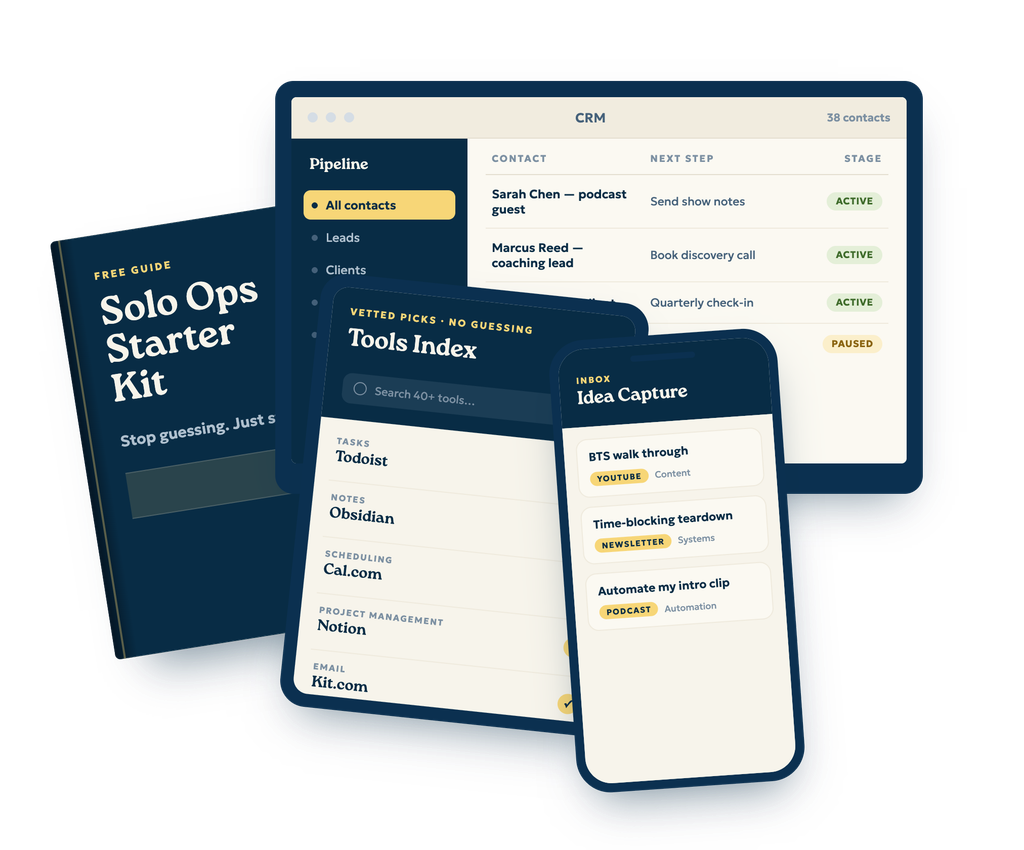
I call this the Solopreneur Sweep
It’s a full, self-guided audit of your business so you can get an idea of the overall health of your business…and how you can take time off. You can learn more here, or download the full sweep below:
Using the Solopreneur Sweep to Take More Time Off
Now, armed with this new information you can:
- Eliminate wasteful tools and tasks.
- Use the tools you use to automate tasks instead of performing them yourself.
- Delegate tasks to a VA or contractor.
The sweep allows you to understand the problem so you can fix the problem.
From there, it’s up to you to optimize and trust that you can step away for a week without your business crumbling.
That’s what I did, and I couldn’t be happier. I started my business for freedom, and that’s what I’ve given myself. I want to help as many solopreneurs as possible break free as well.
You shouldn’t have to wait until stranded at an airport to get the time off you deserve.
3 Comments